
Finding East Palo Alto Residents
A useful East Palo Alto residents directory search begins with a stable clue and moves outward. An address can lead to a parcel number, an assessed owner, and a recorded instrument. A name can lead to a grantor or grantee in the San Mateo County index, a court party, a business filing, or an obituary. A past year sends the search toward regional city directories, newspapers, census schedules, and local archives. Each source answers a different question, so a result should be labeled for what it actually proves.
The county holds most property, vital, election, and court trails in Redwood City and nearby offices. East Palo Alto City Hall adds municipal records such as permits, planning files, Council packets, and public correspondence. Library databases and community archives add historical names that do not appear in a current roll. None of those sources is a complete list of people who occupy every dwelling. Renters, household members, protected participants, and people who never appear in a public record may remain absent.
The starter sequence below keeps the record trail orderly. Preserve the source, date checked, and exact spelling at each step.
- Start with the San Mateo County Assessor property maps by street address or APN, and save the parcel context.
- Use the assessed owner and legal description as clues, while keeping the tax mailing address separate from the situs.
- Search the RecorderWorks Grantor-Grantee index for the person, document type, APN, or recording window.
- Check the court index, business or license records, and lawful historical sources only when they fit the question.
- When an online record stops, use the counter, mail, library, archive, or focused California Public Records Act request for the named custodian.
East Palo Alto Records Offices
The offices behind an East Palo Alto residents directory are split by record type. San Mateo County ACRE combines the Assessor, County Clerk-Recorder, and Elections divisions, but its portals do not become one universal people search. The City Clerk is the right starting point for municipal agendas, archives, elections, and a public-records request aimed at a city department. The court clerk, library, and state agencies each hold separate trails.
San Mateo County Recorder
555 County Center, Redwood City, CA 94063
650-363-4500
RecorderWorks Grantor-Grantee Search
Online property-document index from 1985 forward; older books and images require the office.
San Mateo County Assessor
555 County Center, 3rd Floor, Redwood City, CA 94063
650-363-4500
Assessor Property Search and Maps
Parcel, APN, situs, assessment, exemption, and mapping clues. Ownership is not occupancy proof.
San Mateo Elections Office
40 Tower Road, San Mateo, CA 94402
650-312-5222
My Election Info
Self-lookup for the voter; a full file requires a permitted purpose and application.
The East Palo Alto City Clerk is at 2415 University Avenue, East Palo Alto, with public-records and archive duties at the City forms and records hub. The county office map matters: a city address does not mean City Hall holds the deed, birth certificate, or court file.
East Palo Alto Resident Records by Parcel
RecorderWorks is the clearest named index for a property-centered East Palo Alto residents directory search. Its grantor and grantee fields are indexed names, not a list of current occupants. Search a surname with a first name, try indexed variants, and use the document type or date range to reduce noise. A grantor conveys or encumbers an interest. A grantee receives an interest or benefit. A lien, power of attorney, or notice may connect a person to land without showing that the person lived there.
Use the county map workflow when the name result needs a location. The official Property Maps instructions direct a user to search by address, APN, assessor map book and page, or parcel and subdivision map volume and page. Online maps are downloadable at no charge; official copies are available at the Redwood City counter. Record the APN, map reference, situs, and neighboring APNs before moving back to the deed index.
A search-field view keeps the method precise:
| Address | Enter the physical address in the address mode, then choose the assessor map or all available recorded maps. |
|---|---|
| APN | Enter the parcel number in the APN mode to bridge street wording and land identity. |
| Assessor map book and page | Use the book and page fields when a map reference is already known. |
| Parcel or subdivision map | Choose parcel or subdivision map, enter volume, select the page, and continue. |
A property map, an assessment roll, and a recorded instrument are linked clues. They are stronger together than a name alone, but they still do not establish who sleeps at an address.
RecorderWorks uses a different search vocabulary for deeper work: name, document number, document type, map, recording date, book and page, legal description or APN, and predefined searches. APNs are entered as nine digits without dashes. The public web index covers property documents recorded since 1985, while the counter bridges earlier books, fiche, and document viewing.
The RecorderWorks search screen shows the county grantor-grantee starting point for a property record trail.
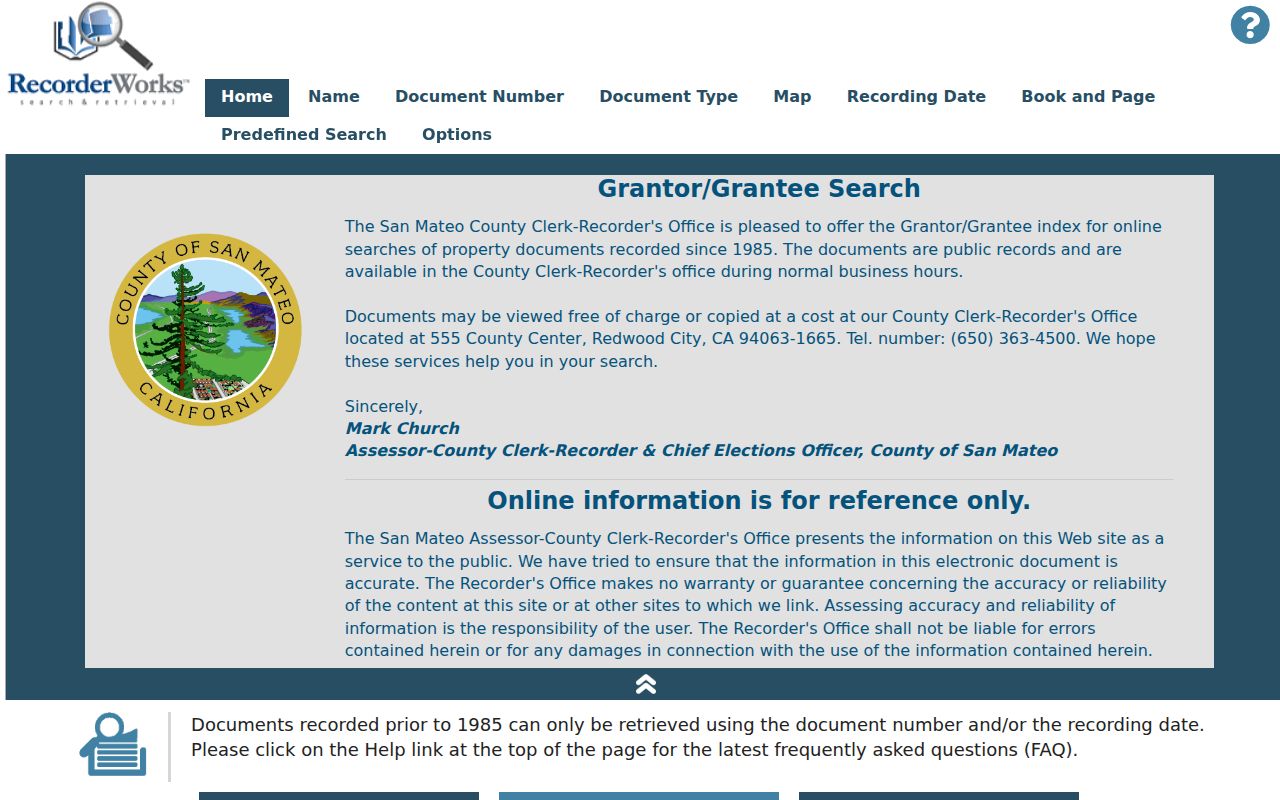
The index is a pointer to parties, dates, and document categories. For a certified copy or a pre-1985 instrument, the county office remains the source.
East Palo Alto Recorder Records Since 1985
One number shapes modern property research: RecorderWorks begins with documents recorded in 1985. East Palo Alto incorporated on July 1, 1983, so the first two city years fall just before the online index begins. That is a useful research boundary, not evidence that older deeds are missing. Deed books, fiche, recorded maps, microfilm, and counter viewing carry the trail backward.
At the counter, a researcher performs the title search. Recorder staff can explain access and copy procedure, but they do not construct a family chain or certify that same-name parties are one person. Mail requests should identify grantor or grantee, document type, approximate recording date, and document number when known, then include payment and a self-addressed stamped envelope. A regular recorded-document copy is $5 for the first page or document and $1 for each added page; certification adds $5 and a conformed copy is $10, according to the county copy guidance.
Older title trail. If an East Palo Alto deed search stops at 1985, switch to the Recorder counter and index books before assuming the address has no earlier record.
East Palo Alto Property Records
The assessor roll can show an assessed owner, APN, situs address, tax mailing address, assessed land and improvement values, and exemptions. These fields describe the parcel and the tax relationship. A mailing address away from the situs can reflect a second property, a trust, an agent, a move, or a notice destination. It is not a live occupancy statement.
The county change-of-mailing-address form makes that separation plain by asking for APNs, owner identity, property location, new mailing address, whether the property was sold or rented, a move date, and owner or agent contact information. The form is evidence that tax correspondence is maintained separately. It is not a public roster of residents. For household questions, the assessor clue should be paired with a directory, a court or probate record, a city permit, or another source whose date and purpose fit.
County address and APN map instructions show how an address becomes a parcel search. The captured county map view below belongs to that starting step.
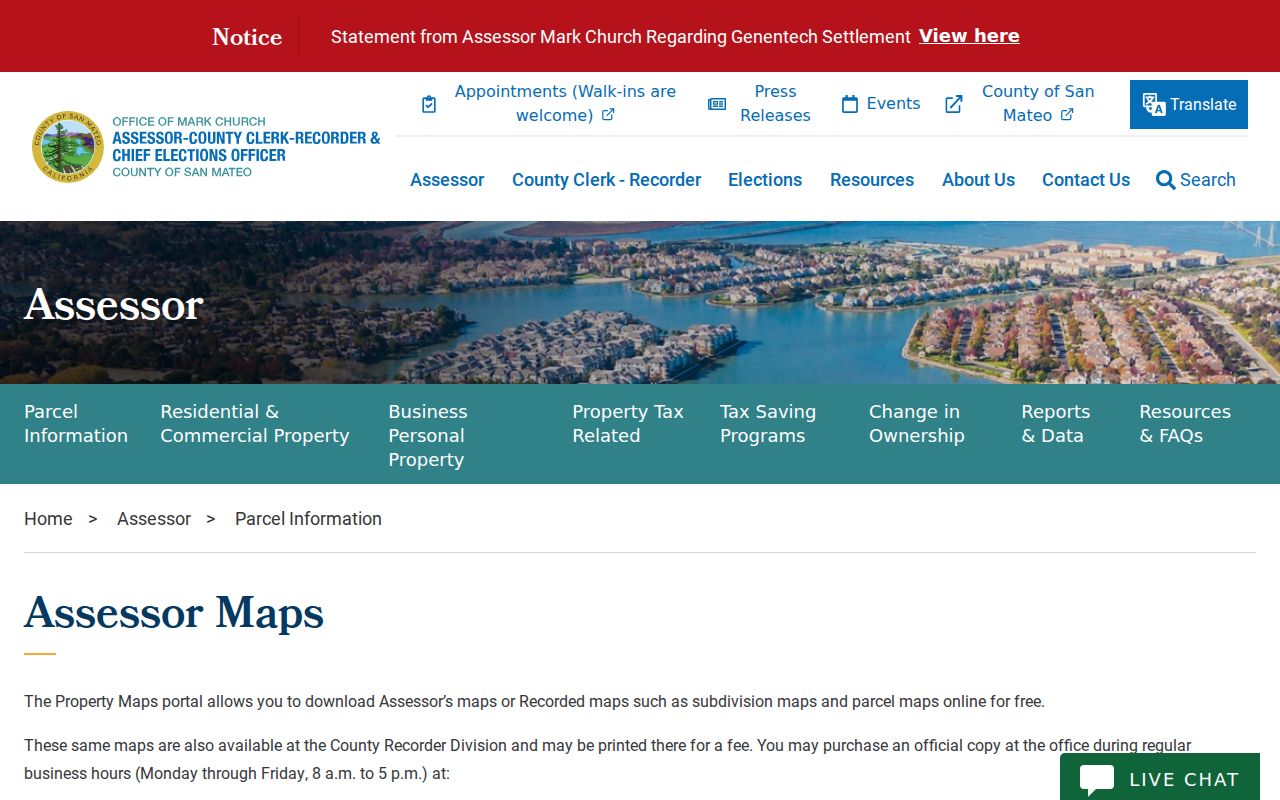
Once the parcel is known, the same APN can connect mapping, assessment, tax, and recorded-document sources without treating a street string as a complete identity key.
East Palo Alto Court Records
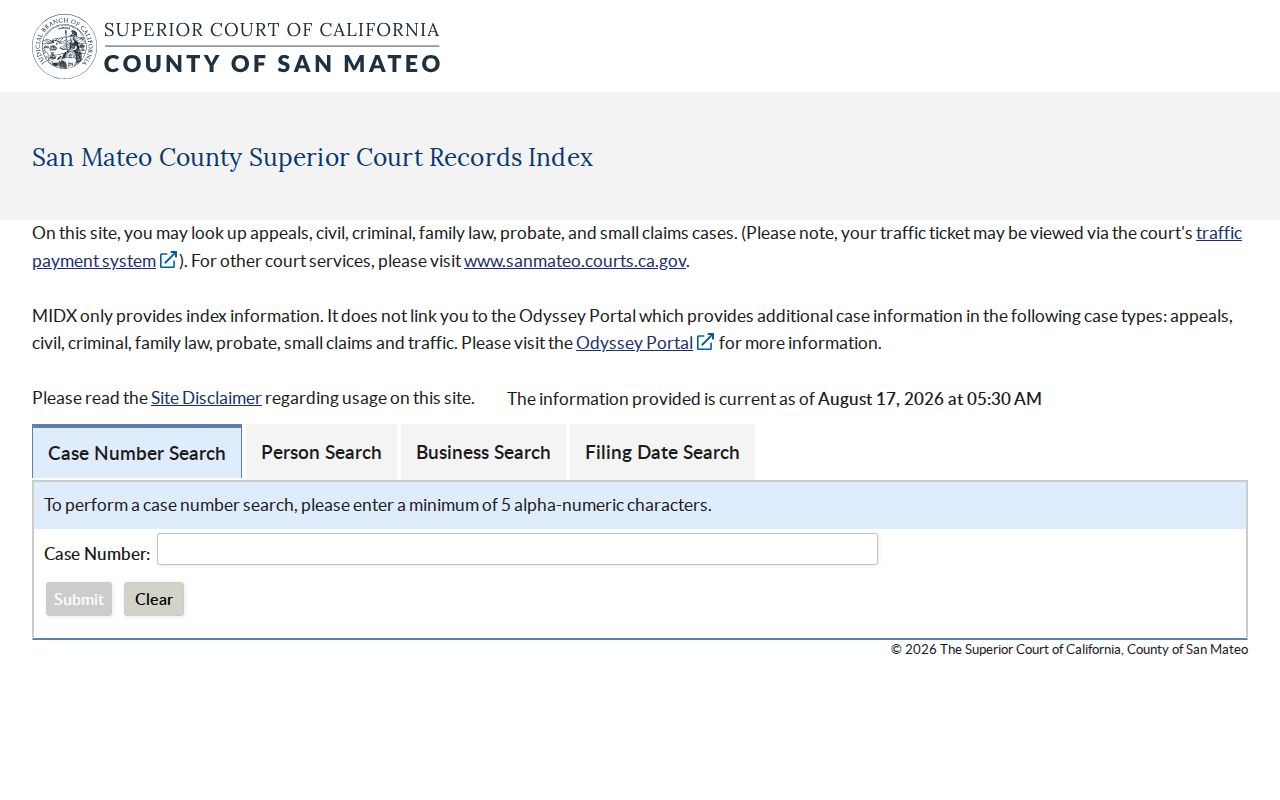
San Mateo County has two public court tools with different depth. MIDX is a compact index for non-confidential appeal, civil, criminal, family-law, probate, and small-claims information. It offers case-number, person, business, and filing-date modes. Person searches require at least two characters in each name field, and an asterisk can serve as a wildcard. Filing-date searches cover no more than five calendar days.
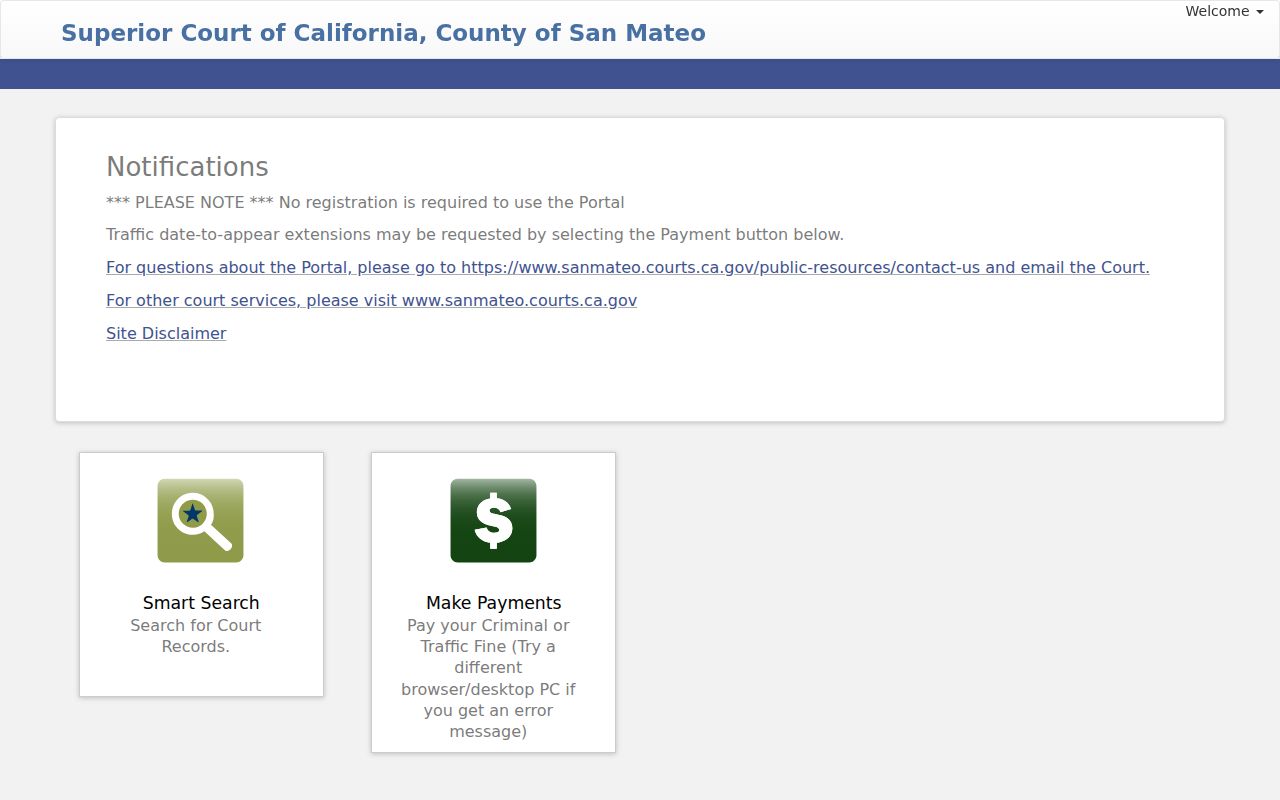
Odyssey Public Portal adds registers of action and some eligible documents without registration. Public results can show case number, caption, party roles, filing date, case type, status, hearings, events, and linked filings when available. Adoption, juvenile, paternity, mental-health, sealed, and other confidential material is excluded. Family-law documents have additional limits. A court hit is a party-and-case clue, not proof that a same-name person is the East Palo Alto resident being sought.
The San Mateo court MIDX capture shows the separate case-number, person, business, and filing-date modes.
Odyssey Public Portal gives a second layer when a public register or document is eligible for remote viewing.
For a fuller file, the Hall of Justice and Records in Redwood City, lobby computers, Records Management, or a court mail-copy request may be needed. Probate can connect an heir, representative, and property, but the petition and decree must be read rather than inferred from a case caption.
East Palo Alto's Current Resident Rolls
Current records that resemble an East Palo Alto residents directory are really different kinds of rolls. The assessment roll is parcel-centered. The voter tool is voter-centered and self-authenticated. The recorder index is instrument-centered. City staff pages are affiliation records, and community organizations publish contacts rather than membership lists. The distinction protects against turning a useful clue into an unsupported claim.
| Source | What It Can Show | Keeper | Access |
|---|---|---|---|
| Assessment and parcel maps | APN, situs, assessed owner, tax mailing and map context | San Mateo County Assessor | Web maps and counter copies |
| RecorderWorks index | Recorded parties, roles, document type and date | ACRE Recorder | Free reference index since 1985 |
| My Election Info | A voter’s own status, party, precinct and districts | San Mateo Elections | House number, ZIP and birth date for the voter |
| City Clerk and departments | Agendas, permits, projects, public correspondence and staff contacts | East Palo Alto | Online files, counter, or CPRA request |
| Business and license records | Entity agents, officers, license status and professional affiliation | California agencies | Free official searches |
For one person, compare two stable keys such as an APN and a middle name, or a case date and a business filing. An entry in the East Palo Alto residents directory is strongest when the source, date, role, and limitation stay attached to it. A person can own a parcel without living there, appear in a court file without being a resident, or operate a business at an address without using it as a home.
East Palo Alto Voter Records
California’s public-facing voter path is a self-lookup, not an unrestricted East Palo Alto residents directory. My Election Info asks the voter for house number, ZIP code, and birth date. Results can include registration status, party, precinct, districts, pamphlet preference, and election information. The telephone fallback is 650-312-5222, and the San Mateo Elections office is at 40 Tower Road.
California Elections Code section 2194 allows specified election, scholarly, journalistic, political, and governmental uses of voter files after an application. Government Code section 7924.000 protects addresses, phone numbers, email, registration numbers, prior registration, identifiers, and signatures except under narrow access rules. A lawful authorized file can include registration and participation fields, but participation shows that a ballot was cast and by which method, never the selections on the ballot.
California My Voter Status is designed for the voter’s own record. A failed match may be an input problem, a recent update, a protected record, or no registration. It is not proof that a person does not live at an address.
The voter-status capture below illustrates the self-service boundary.
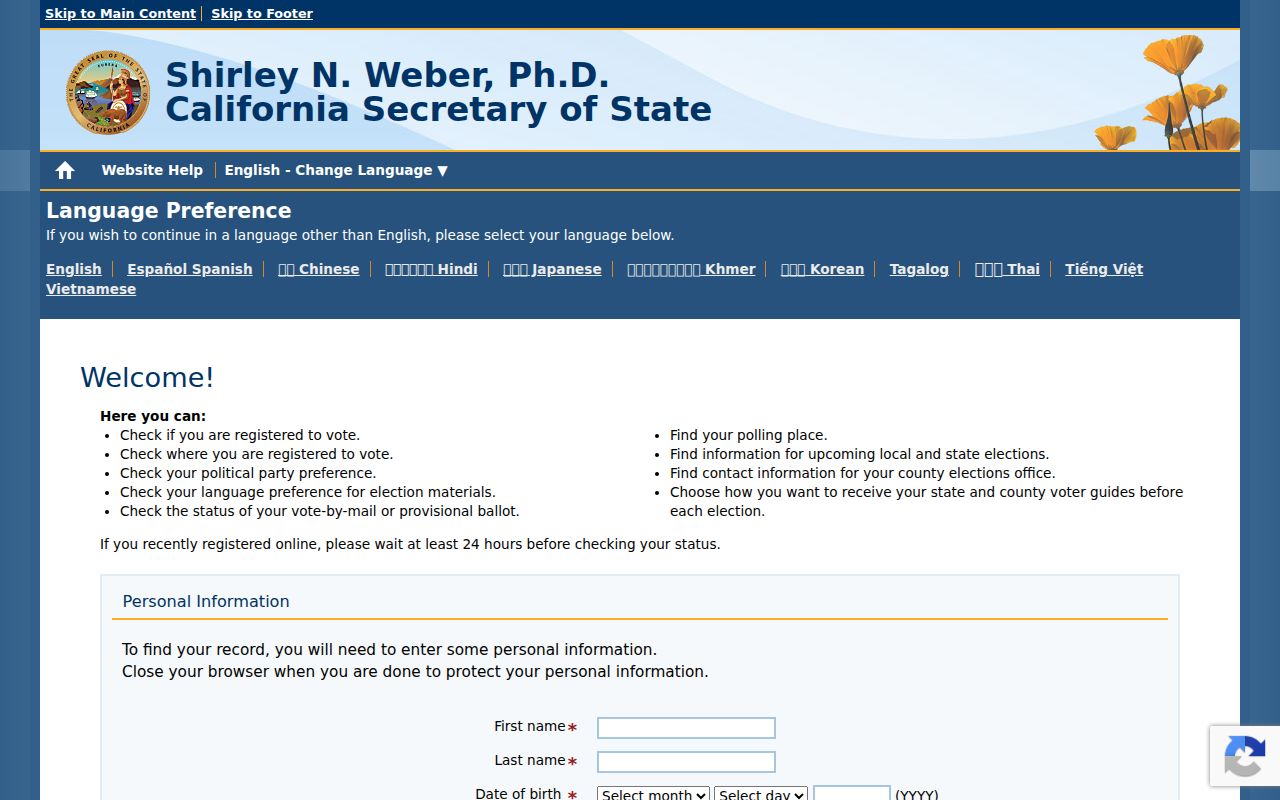
That authentication step is why voter data should be handled as a protected election record, not copied into a general neighbor list.
East Palo Alto City Hall Files
City Hall becomes the right first stop when the clue is a permit, planning project, Council action, city election, police-record request, or local administrative file. The City Clerk at 2415 University Avenue maintains public-record and archive access and coordinates Council agendas, minutes, videos, and elections. The city forms hub can help identify the request path. A California Public Records Act request should name the department or custodian, subject or address, date range, document type, and preferred delivery method.
The usual CPRA determination period is ten calendar days, with a written extension of up to 14 days in unusual circumstances. That period determines whether responsive disclosable records exist; it is not an automatic production deadline. The city need not create a new record to answer a question. Permit files can show an applicant, owner, contractor, scope, status, valuation, parcel, and inspection milestone, but an applicant can be an agent or contractor rather than an occupant. Plans have copying limits under Health and Safety Code section 19851.
East Palo Alto’s public-records entry point shows the city route for local requests.
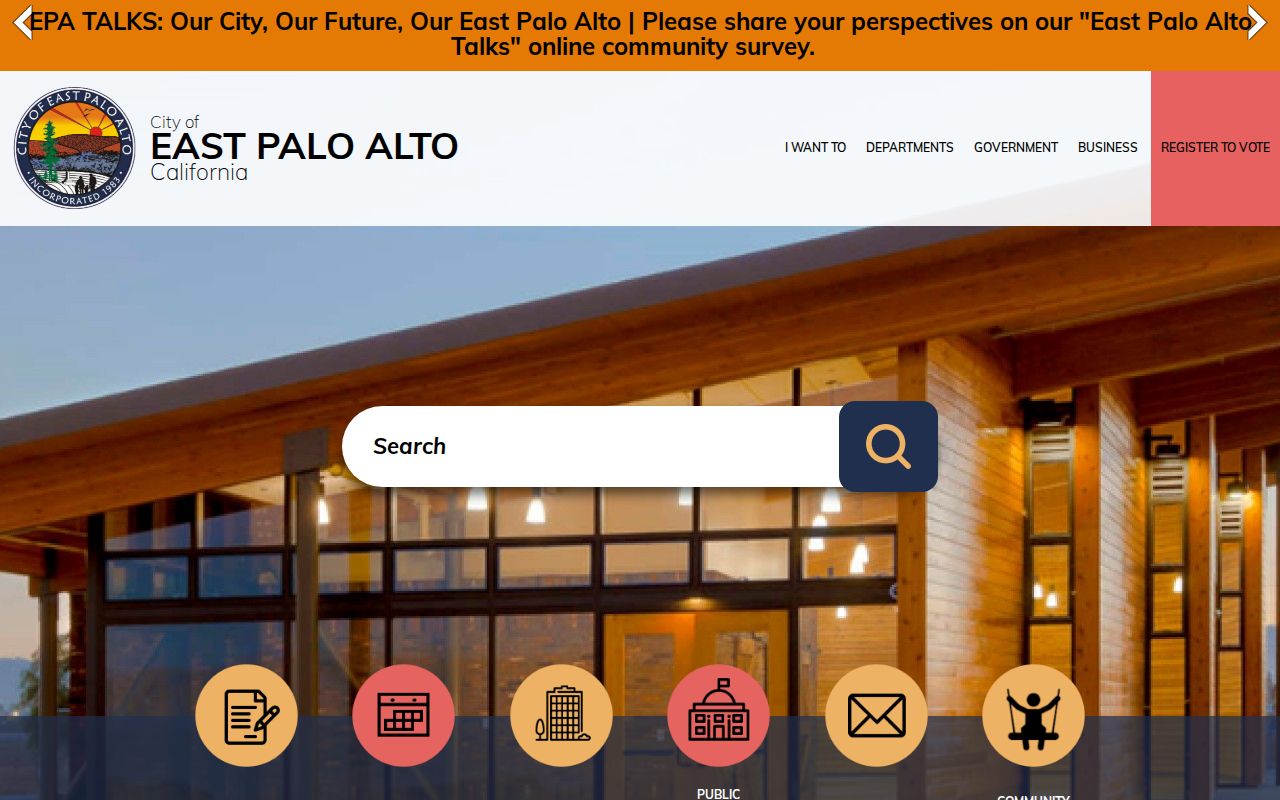
City records document participation in a project or civic process. They should not be relabeled as a residence record without a separate source.
East Palo Alto Vital Records
Birth, death, marriage, and dissolution records follow eligibility rules that differ from ordinary public indexes. San Mateo County ACRE issues county birth, death, and marriage records. The local registrar handles current and previous-year births and deaths, while California Department of Public Health maintains statewide records. Authorized certified copies of birth and death certificates are limited by Health and Safety Code sections 103525 and 103526. Other requesters may receive an informational copy marked not valid to establish identity.
Public marriage records are generally obtainable, but confidential marriage records are limited to a spouse or court order. A CDPH dissolution certificate is not the full divorce decree or court file. Historical indexes, newspapers, church records, census schedules, and library databases serve genealogy when modern certificates are restricted. County 2026 fees listed by ACRE are $34 for birth, $26 for death, and $19 for marriage; CDPH lists $31, $26, $19, and $18 for birth, death, marriage, and dissolution requests respectively.
The county vital-record fee page is the source to check before mailing an application, because payment, notarization, relationship, and certified-copy type affect acceptance.
East Palo Alto's Business Cross-Checks
Business and professional records can confirm an affiliation when a name search needs a second official source. California Secretary of State bizfile supports a name or file-number search, Business and UCC modes, Advanced filters, entity type, status, initial filing date, and begins-with options. Results can show an entity number, standing, jurisdiction, street or mailing address, agent, statement due date, and officer, director, member, or manager data. A business address is an affiliation clue, not residence proof.
The Department of Consumer Affairs search accepts board or bureau, license type, license number, business name, first name, last name, and registry number. Advanced filters can include city, county, status, discipline, and public documents. Profession-specific boards may carry fuller records. San Mateo County fictitious business names are a separate ACRE trail, and East Palo Alto business-license administration is through HdL; a public licensee register was not verified.
California business search gives the entity-side check.
For a person whose clue is a professional credential, DCA license search adds the board and license side.
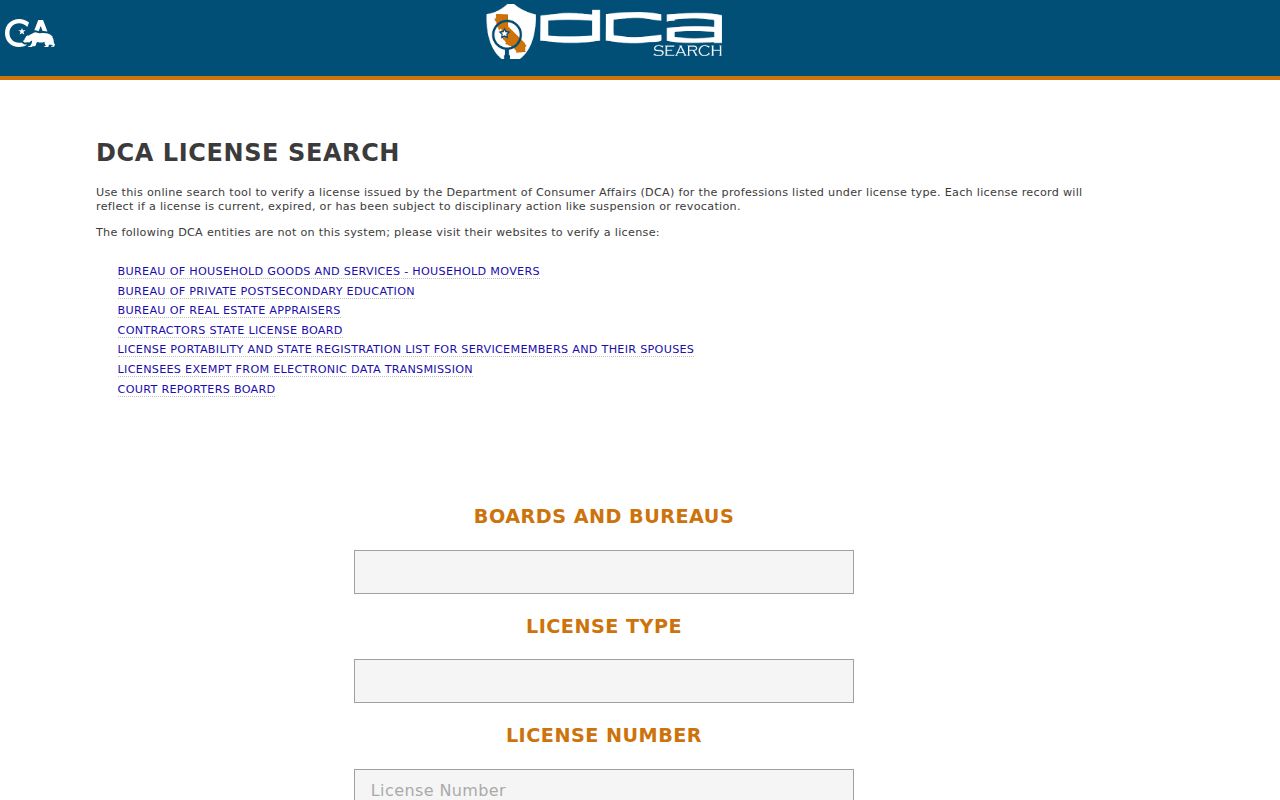
Match names, dates, entity numbers, and roles before treating two entries as one identity.
East Palo Alto Historical Directories
The historical side of an East Palo Alto residents directory sits inside regional Palo Alto city directories. Stanford’s inventory lists Green Library holdings from 1896/97 through 1978, with Kinkead, Stanford University Press, Times Publishing, Willis Hall, and R.L. Polk among the publishers. The Palo Alto Public Library fills many gaps under call number 979.473 P769p. The 1926-forward Polk volumes add a street-address section, which makes a house number a route into an alphabetical household entry.
The Stanford directory inventory is more reliable than searching only for a title that says East Palo Alto. NARA’s 1930 directory inventory explicitly places East Palo Alto, Ravenswood, and North Palo Alto inside the Palo Alto regional geography. No volume was published in 1943 or 1945. A missing year can reflect nonpublication, a move, an unlisted entry, or a change in place-name coverage.
For a deeper collection walkthrough, use the East Palo Alto city directory page. It is the historical shelf, while current parcel work belongs with the county map and recorder sources.
San Mateo County Libraries provide local-history and genealogy databases, including HeritageHub obituary coverage, HeritageQuest, My China Roots, and Ancestry Library Edition at a library location or its Wi-Fi. The local library connection matters because remote Ancestry access is no longer available.

A directory entry can name a household at a particular publication date. It cannot by itself prove ownership, current residence, or every person living in the dwelling.
East Palo Alto Place Names
Historical geography can hide a person in plain sight. Ravenswood was platted in 1851, the Runnymede or Weeks colony developed from 1916, and East Palo Alto became the common name by the 1920s. The city was not incorporated until 1983. A directory, deed, census schedule, or newspaper may use East Palo Alto, Ravenswood, Runnymede, Palo Alto, or Menlo Park for a place now understood as one community.
The 1939 county street renumbering and renaming adds another bridge. The Historic Resources Inventory reports changes such as Palo Avenue to Park Street, Stanford Avenue to Oakwood Avenue, and Birch Street to Doyle Street. A modern street search can therefore miss an older address. Use the APN, legal description, recorded map, census geography, and the scanned historic table rather than copying a modern street name backward.
This geography is also why a current East Palo Alto residents directory search should preserve the source’s original title and place label. Search variants, then verify the parcel or household with a second record.
East Palo Alto Privacy Tools
California’s address protections matter when a public-record trail creates risk. Secretary of State Safe at Home provides an eligible participant with a substitute mailing address and confidential voter-registration route. Government Code section 6209.5 can permit a substitute address on certain real-property documents, but enrollment does not erase older public records. A participant should contact the program and the relevant custodian before using an ordinary online form.
For commercial data copies, California’s DROP portal at CalPrivacy sends one deletion or do-not-sell request to registered brokers after a resident creates an encrypted profile. The Attorney General reported in February 2026 that the tool reached more than 500 brokers, with deletion duties beginning August 1, 2026. Broker removal does not change a deed, assessment, court index, license filing, or city record. Corrections must go to the office that created the record.
Lawful personal use. Public records support family history, address research, and civic understanding. Do not use a person lookup to stalk, harass, intimidate, or harm anyone, and do not republish protected information.
The practical sequence is custodian correction first, privacy-tool request second, and confirmation tracking throughout. Preserve request dates and reference numbers. Share only the identifiers a custodian or privacy program truly needs.
East Palo Alto Directory Terms
Four terms keep an East Palo Alto residents directory search from overclaiming:
| Roll | An official list or account set, such as an assessment roll or voter file, with its own keeper and access rule. |
|---|---|
| Index | A finding aid for records. RecorderWorks points to an instrument; it is not the complete deed image. |
| Parcel | A mapped unit of land identified by an APN and legal description. A parcel is not the same as a household. |
| Criss-cross directory | A reverse directory that starts with a street and house number, then points to a named listing. |
The words matter because an owner, a voter, a court party, a business officer, and a directory name may all refer to different relationships with one address. Keeping those roles visible is the core of accurate local research.