
East Palo Alto Resident Lookup Coverage
A one-person resident lookup works only when each record is read for the question it can answer. Property records can identify an assessed owner and parcel. A recorded instrument can identify a party role. A court index can identify a case connection. Vital records can document an event when the requester is eligible. Business, license, and unclaimed-property results are useful clues, but an affiliation or historic report is not proof of a current home.
The table below separates the main trails available for East Palo Alto and San Mateo County. A careful resident lookup should move from a broad name search to a stable key, then to the custodian’s underlying record.
| Record | What It Confirms | Where | Access |
|---|---|---|---|
| Assessment roll | Ownership candidate, parcel, situs, and separate mailing field | County GIS and Assessor | Web and counter; owner is not occupant |
| Recorded instrument | Indexed party role and property transaction | RecorderWorks from 1985; older counter records | Free index; images and copies through the Recorder |
| Voter self-lookup or file | Own status, party, precinct, or limited authorized fields | My Election Info and approved Elections request | Self-authenticated or lawful-purpose application |
| Court record | Party or case role, dates, status, events, and eligible filings | San Mateo MIDX and Odyssey | Free index; remote documents vary by case type |
| Vital record | Birth, death, marriage, or dissolution event | County Clerk-Recorder, CDPH, historical indexes | Eligibility, copy type, and fee rules apply |
| Business or license record | Entity, agent, officer, license, or professional affiliation | bizfile and DCA search | Free basic searches; affiliation is not residence |
| Unclaimed property | Owner or reporting-business clue | California State Controller | Free search and claim initiation; may be stale |
Start with the record that matches the known fact. An address points toward GIS and the assessor. A case question belongs in MIDX or Odyssey. A family event belongs with the vital custodian or a historical index. A business connection belongs in an entity or license file. This order limits false matches and keeps a lookup from becoming a pile of unrelated names.
Verify an East Palo Alto Resident
Names change shape in public indexes. Initials, compound surnames, accents, spelling changes, and last-name-first entry can all split one person across records. Start with the exact form supplied by the record keeper, then add a second stable key. An APN or legal description is stronger than a street spelling. A case date and party role are stronger than a bare case-name match.
Use a source-backed sequence rather than trying to fill a missing fact with a guess:
- Normalize the name, including initials, compound surnames, likely punctuation changes, and last-name-first variants.
- Anchor the candidate with an official property, business, license, or other lawful record. Keep the party role and the record date.
- Search the San Mateo court person tools with the required fields and wildcard rules. Compare case type, filing date, role, status, and events.
- Use a vital index or certificate only through its eligibility route. Do not guess another person’s birth date and do not test protected data.
- Obtain the source copy when needed, then compare two stable keys before treating names as the same person.
- Docket
- The court’s case record or case file, including the identifying number, parties, events, hearings, and eligible filings.
- Index versus image
- An index is a pointer with fields such as name, date, or document number. An image or file is the underlying instrument or filing.
- Certified copy
- A copy issued or certified by the custodian as an official reproduction for a purpose that accepts certification.
- Party role
- The person’s position in the record, such as grantor, grantee, petitioner, respondent, plaintiff, defendant, heir, agent, or officer.
East Palo Alto Court Lookup Fields
East Palo Alto cases belong to the Superior Court of California, County of San Mateo. MIDX is the compact index. It covers nonconfidential appeals, civil, criminal, family-law, probate, and small-claims index information, while traffic uses a separate system. The page reports when its data was refreshed and has distinct search modes.
| Mode or Field | Type | Required | Format and Limit |
|---|---|---|---|
| Case Number | Text | Yes in case mode | At least five alphanumeric characters |
| First Name | Text | Yes in person mode | At least two characters; append * for a wildcard |
| Last Name | Text | Yes in person mode | At least two characters; wildcard supported |
| Business Name | Text | Yes in business mode | At least three characters; wildcard supported |
| Date From | Date | Yes in filing-date mode | MM/DD/YYYY; range cannot exceed five calendar days |
| Date To | Date | Yes in filing-date mode | MM/DD/YYYY |
| Search tabs | Mode control | Not applicable | Case Number Search, Person Search, Business Search, Filing Date Search |
The court’s online case access explanation distinguishes MIDX from Odyssey. For a resident lookup, that choice matters because Odyssey requires no registration, accepts party or case criteria, recommends an asterisk for incomplete names, and offers Advanced Filtering Options. It can display registers of action for eligible civil, criminal, family, probate, small-claims, and traffic matters, but adoption, juvenile, paternity, and mental-health cases are excluded. Family-law documents are not broadly displayed, and remote criminal access is more limited.
The San Mateo court access guide shows the distinction between MIDX and Odyssey.
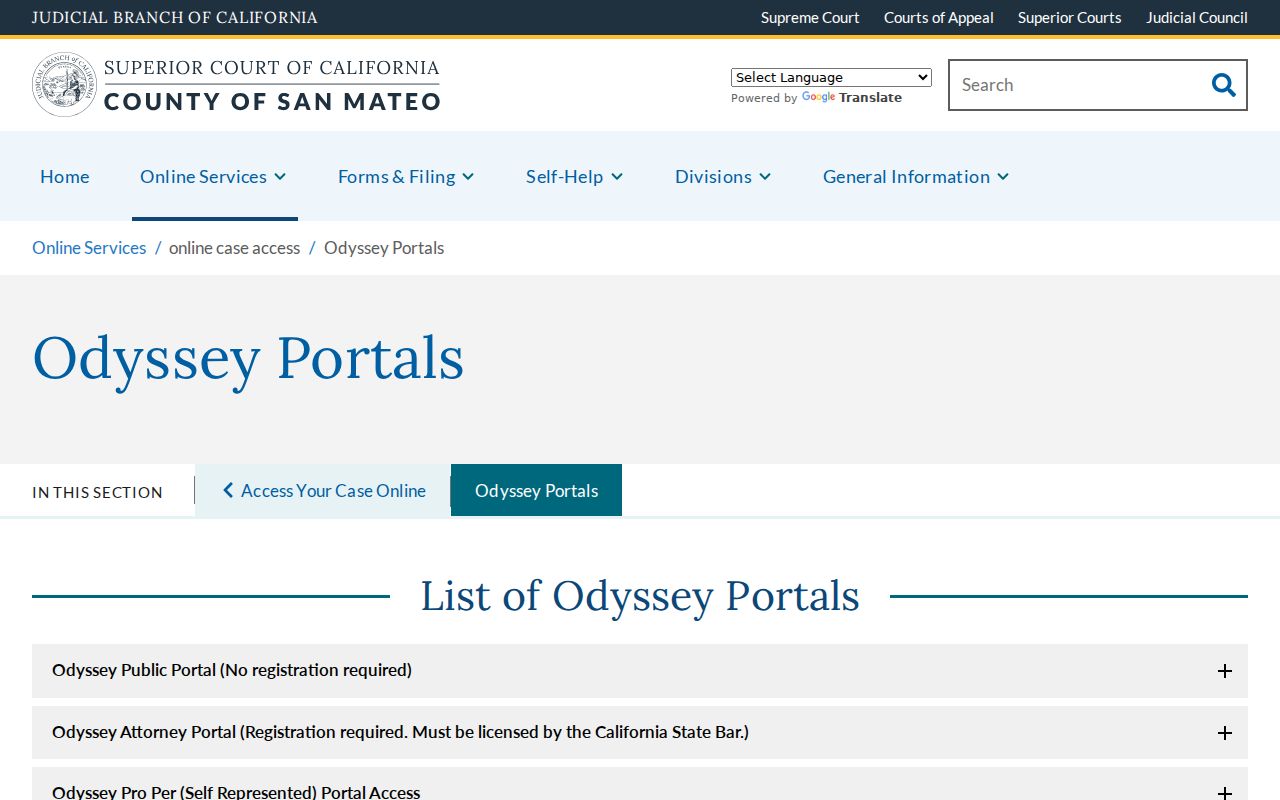
The San Mateo court access screen is the right reference for choosing MIDX or Odyssey. A name hit still needs a role, date, case type, and a second source.
East Palo Alto Resident Court Results
Odyssey supplies more context than a bare index when the case category permits it. Converted cases from January 1, 2000 through June 15, 2016 use prefixes such as FAM, CLJ or CIV, PRO, SCS, SCC or SCN, and criminal NM, NF, SC, SF, or SM. Native post-June 15, 2016 numbers ordinarily begin with the filing year, a three-character type, and a number. Older event codes may not map cleanly to the newer display.
A public result can expose several fields. Record them without turning an allegation into a fact:
- Case number, caption, party names, and the role assigned to each party.
- Filing date, case type, status, and judicial assignment.
- Events, hearings, and the register of actions.
- Eligible linked filings or documents, with sealed and confidential material hidden.
- The search source and date, since the index reports its refresh state.
For a file omitted from remote access, the Hall of Justice and Records at 400 County Center, Room A, Redwood City, and Records Management are the practical fallback. The published court contact is 650-261-5100, with weekday counter and phone service listed from 8:30 a.m. to 1 p.m. by appointment. Researchers may request five files at a time; an offsite file is held for five working days after retrieval.
Mail requests should name the case number, parties, approximate filing date or document description, a self-addressed stamped envelope, and a blank check with a not-to-exceed cap. The court says it responds within 30 days and does not perform research. Local published charges include $0.50 per side, $15 for a dissolution certified copy, $40 for certification, $50 for exemplification, $1 per side for comparison, $15 for a search over ten minutes, and $10 for offsite retrieval. Verify charges before ordering.
Note: A court clerk can explain access and copy procedure, but the clerk cannot certify that two same-name parties are the same human.
East Palo Alto Federal Lookup
Federal litigation involving an East Palo Alto person is searched separately through the U.S. District Court for the Northern District of California. PACER requires an account. The PACER Case Locator searches nationwide, while a district search can narrow the result. Current federal charges are assessed by page under the published schedule, with quarterly fee waivers below the stated threshold; judicial opinions are generally free.
Use the official docket when certification or a complete procedural history matters. RECAP or another copy can help locate a filing, but it is not a substitute for the official docket. Compare the party role, district, case number, filing date, and docket events before treating a federal result as a match.
The official PACER access page is the source for federal case-search entry and account information.
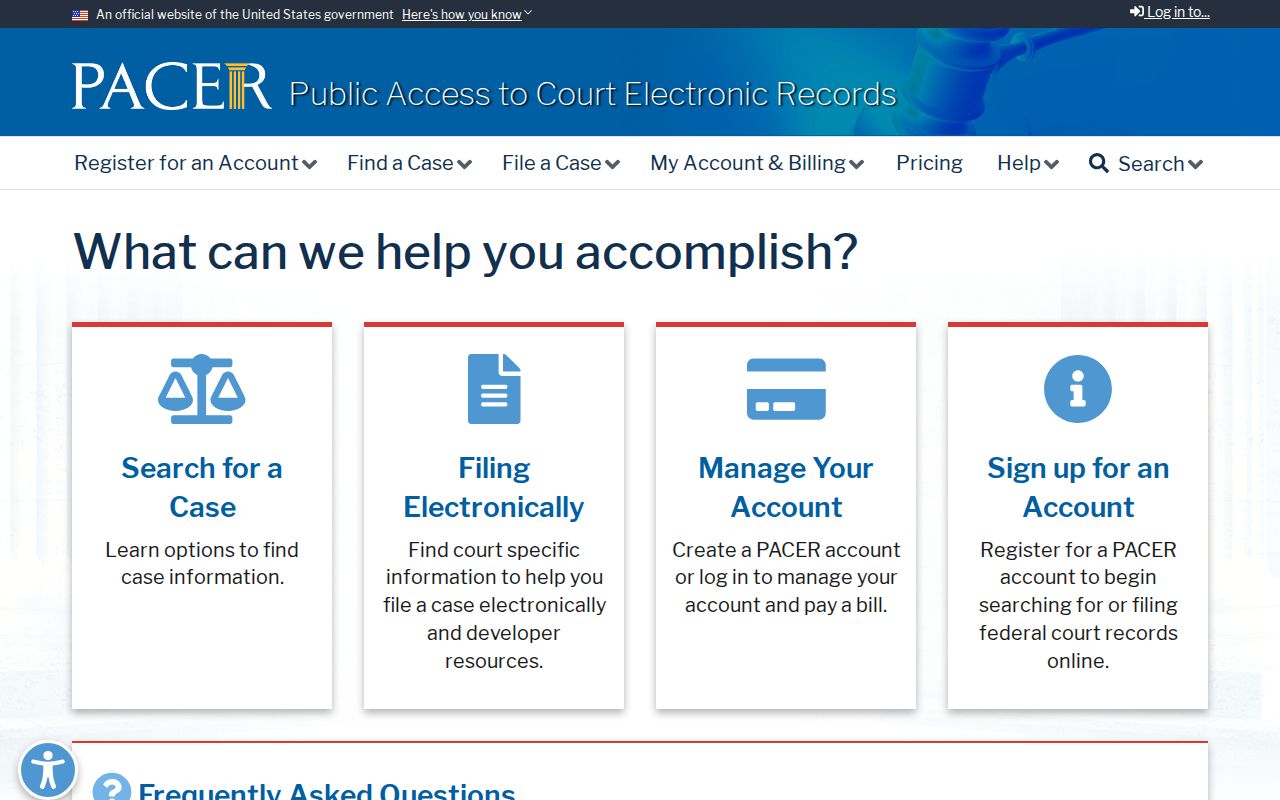
PACER belongs in the verification chain only when the question reaches federal court. It does not replace the San Mateo county case tools.
East Palo Alto Vital Records Need Eligibility
California separates an authorized certified copy from an informational certified copy. Birth and death access follows Health and Safety Code sections 103525 and 103526. An informational copy is marked as not valid to establish identity. Public marriage records are broadly obtainable, while a confidential marriage certificate is limited to a spouse or court order. Adoption and original birth records are sealed unless the statutory or court process applies.
| Record | Custodian or Route | 2026 Fee in Research | Eligibility and Limit |
|---|---|---|---|
| Birth | San Mateo Clerk-Recorder, local registrar, or CDPH | County $34; state $31 | Authorized or informational copy rules |
| Death | County, local registrar, or CDPH | $26 county and state | Authorized or informational copy rules |
| Public marriage | San Mateo Clerk-Recorder or CDPH | $19 county and state | Public record route; availability varies by custodian |
| Confidential marriage | County of issue | $19 where eligible | Spouse or court order |
| Dissolution report | CDPH; full file at San Mateo Superior Court | CDPH $18 | Report is not the decree or court file |
The state’s 2026 schedule also lists fetal death at $23 and stillbirth at $28. A no-record search returns a Certificate of No Public Record and keeps the fee. CDPH’s current vital-record fee schedule should be checked before mailing. CDPH accepts a U.S.-bank check or money order, not cash. The application forms ask for the applicant’s name, mailing address and contact, copies, registrant or decedent names, event date and place, applicable parent or spouse fields, purpose, relationship or authorized category, signature, date, sworn statement, notary acknowledgment when required, and payment.
The county vital-record fee page is the source for local birth, death, and marriage charges and request channels. The state route is useful for statewide records, while historical indexes, newspapers, church sources, census schedules, and libraries provide a separate genealogy path. California does not use a simple rule that automatically opens every modern certificate after a single number of years.
The San Mateo County vital-record fee page is the source for the local copy charges and request path.
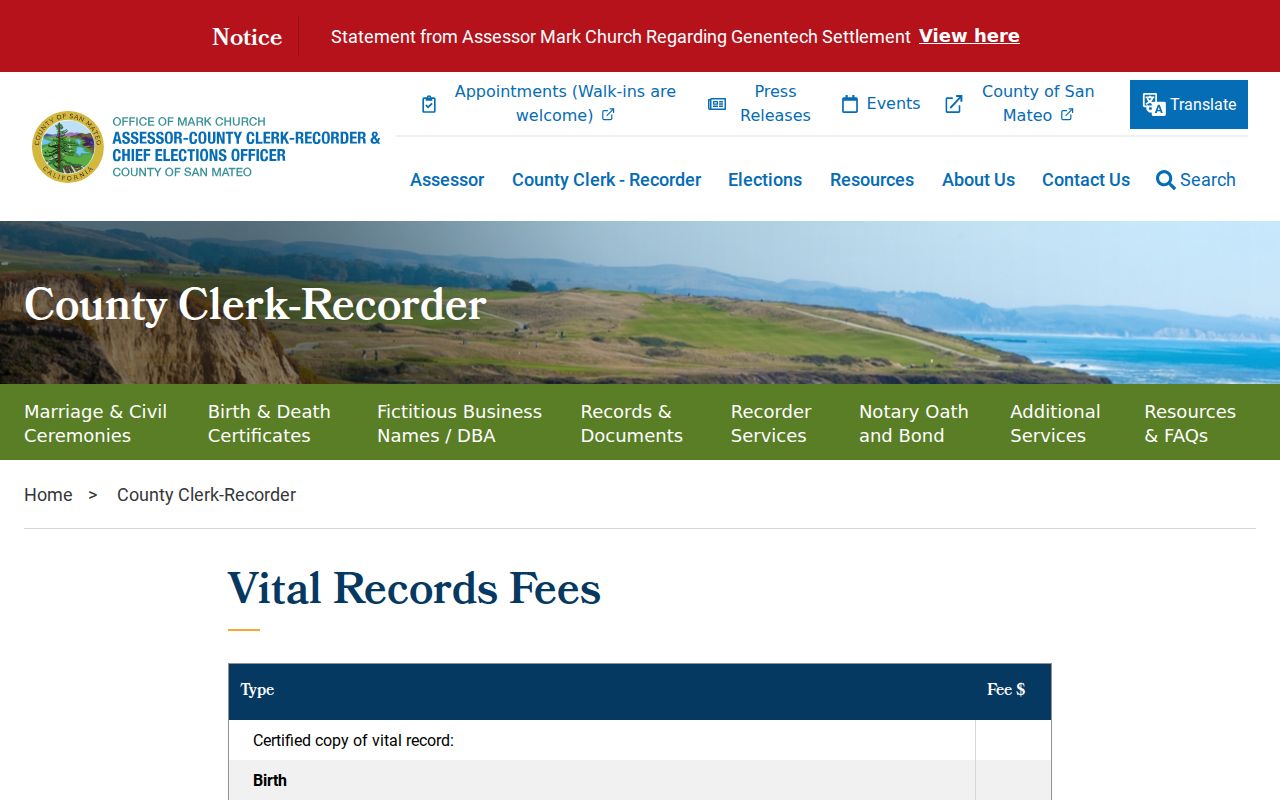
The county vital-record page makes the copy type and fee distinction visible. It should be checked before sending a request because eligibility controls the document that can be issued.
East Palo Alto Voter Self-Lookup
San Mateo My Election Info asks for the voter’s house number only, ZIP code, and birth date through month, day, and year selectors. It can return registration status, party affiliation, precinct number, districts, pamphlet preference, and election information. The tool is designed for the voter’s own record. It is not a name search for another person and not a street directory.
California’s My Voter Status route also serves self-status work. A full voter file is different. Elections Code section 2194 permits election, scholarly, journalistic, political, and governmental uses after application, while protected addresses, identifiers, signatures, prior registration, and other fields remain confidential except under narrow access rules. An approved file may include residence or mailing address, party, status and method, precinct, birth date, gender, language, and participation history, but participation never reveals ballot selections.
San Mateo Elections lists 650-312-5222, 1-888-SMC-VOTE, call or text service, and 40 Tower Road, San Mateo, CA 94402. File charges in an older county candidate guide included $125 for an electronic file, but current 2026 form and fees were not verified. Confirm the current application with Elections or the data contact before requesting anything. Never guess another person’s birth date or try to evade the authentication step.
The Secretary of State’s voter information file request image shows the authorized-access route, not an open resident search.
The California voter information file request shows the authorized-access route.
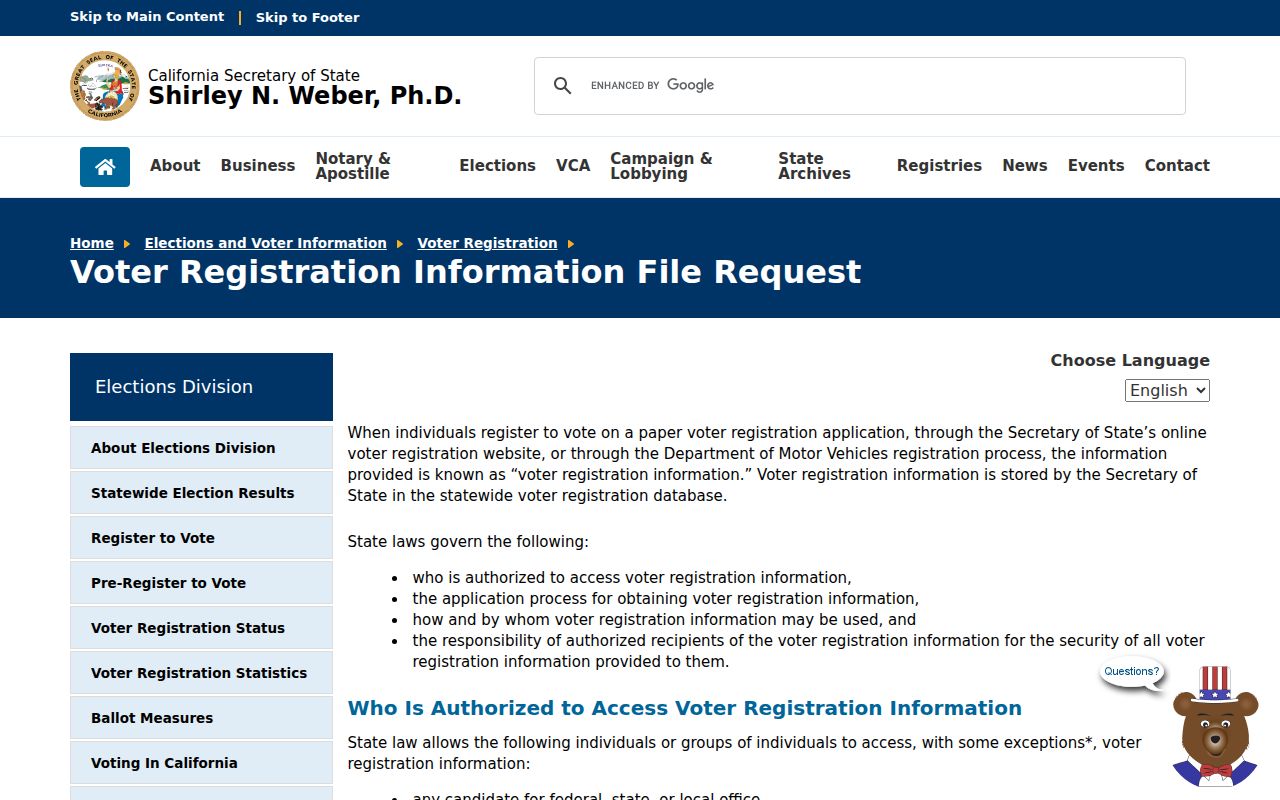
The request form belongs after the self-lookup distinction is clear. A lawful purpose and current approval rules must be established before any file is considered.
East Palo Alto Heir and Classmate Lookup
An heir trail begins with a probate case, not a broad name list. MIDX or Odyssey may reveal a probate case number, party role, filing date, events, and eligible filings. Read petitions, notices, appointments, and a decree of distribution, then connect any property transfer through the recorder. An obituary can supply a death endpoint or family clue. It does not prove a present address.
Birth-parent questions require California’s official adoption and court access process. Original birth and adoption records are sealed unless the statutory route applies, so a resident lookup should never suggest bypassing that protection. A classmate trail can use yearbooks, regional city directories, newspapers, the East Palo Alto Community Archive, and local library help. Older name and address work belongs in the East Palo Alto city directory collections, where regional titles and street sections are explained.
EPACA’s incorporation collections, Progress newspaper, oral histories, and community materials are historical or consensual sources. They can reconnect a family or community story without becoming a current membership or residence roll. Keep the collection date, contributor context, and exact name form with every clue.
East Palo Alto Business and License Records
Business and license files are useful cross-checks when a name is tied to a company, professional credential, or public filing. California bizfile’s basic search uses a name or file number and Business or UCC modes. Advanced fields can filter publicly traded disclosure, entity group or type, status, initial-filing date, and begins-with results. A result can show entity name and number, date, status, jurisdiction, street or mailing address, agent, statement due date, officer, director, member, manager, and available PDFs.
The California Department of Consumer Affairs search uses Boards and Bureaus, License Type, License Number, Business Name, First Name, Last Name, and Registry Number. Advanced filters add city or county, primary or secondary status, discipline or public action, and public-document choices. Board-specific searches remain important when DCA directs the request to a Medical Board, nursing, contractor, real-estate, State Bar, or credentialing portal.
East Palo Alto business-license administration is through HdL at 650-223-7740 and EastPaloAlto@hdlgov.com; licenses expire December 31. No public licensee register was identified. An agent-for-service address, officer filing address, or professional practice address is an affiliation or contact point, not residence proof. The California business search should be paired with dates and entity status.
East Palo Alto Unclaimed Property Lookup
The California State Controller’s unclaimed-property search is free and can be searched by owner name, with business name where applicable. A result may show a reporting business or a historic association that helps distinguish same-name people. Claim information does not prove that a person lives in East Palo Alto now. Use the Controller’s official claim route and do not pay a third party to initiate a claim.
The State Controller unclaimed-property search is a clue layer after stronger keys have been checked.
The California State Controller unclaimed-property search provides the official clue layer.
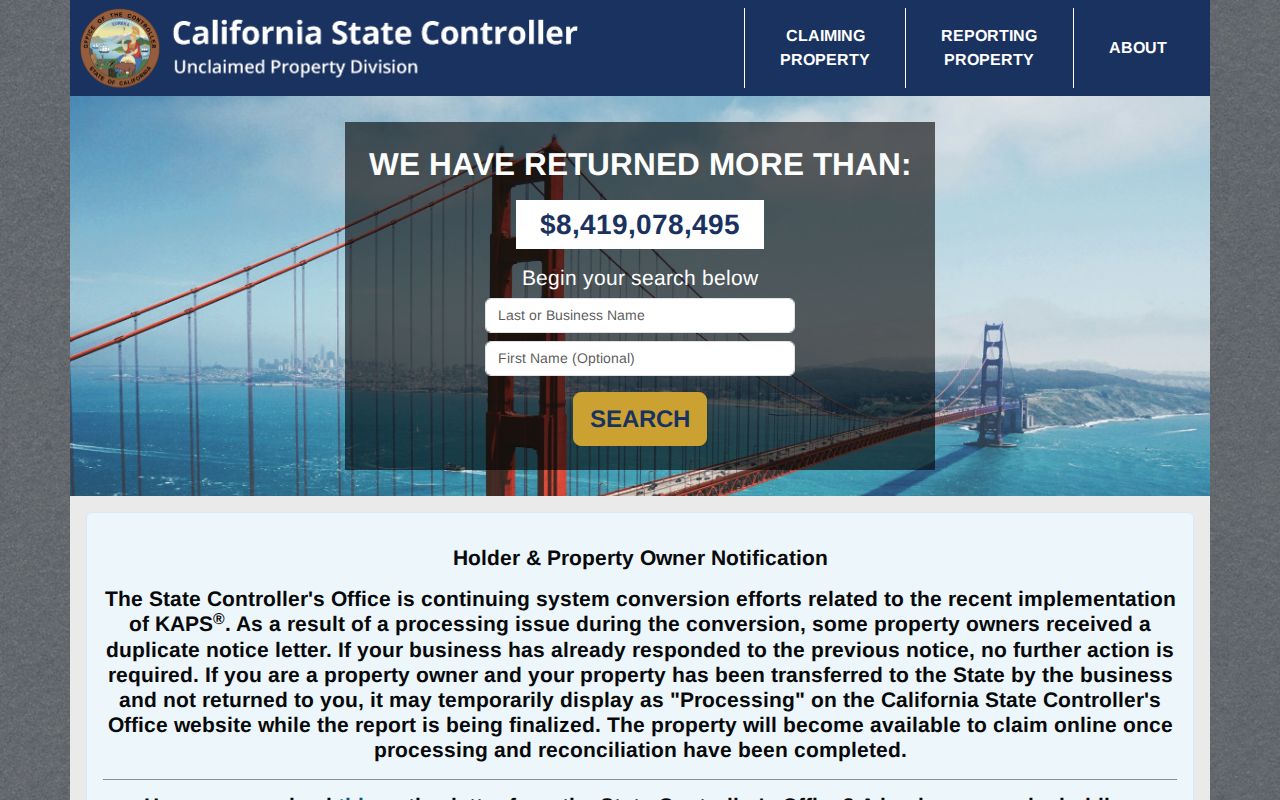
The Controller’s search screen is useful for a name variation, but the reported property and date must be kept separate from current residence.
When the question is custody rather than residence, the California Department of Corrections and Rehabilitation locator searches by name or CDCR number. Its result is custody information, not a current address or complete criminal-history report.
East Palo Alto Resident Privacy Programs
California’s Safe at Home program gives eligible survivors and other protected participants a substitute mailing address and confidential voter-registration route. It does not erase older public records. Government Code section 6209.5 permits a qualified participant to substitute the designated address on certain real-property documents, and the participant should contact the custodian about existing records before using an ordinary form.
California’s DROP portal is a different privacy layer. Under the DELETE Act and California privacy rights, a resident can confirm residency, make an encrypted profile with selected identifiers, and send one deletion or do-not-sell request to registered data brokers. The Attorney General reported in February 2026 that DROP reached more than 500 brokers and that broker deletion duties began August 1, 2026. Removing a broker copy does not amend a deed, assessment, court index, license filing, or voter record.
For an address correction, contact the custodian that created the record: Assessor for roll or mailing fields, Recorder for an index or copy issue, the court clerk for docket procedure, SOS or a licensing board for filings, and Elections for the voter’s own registration. Keep confirmation numbers and submit only the identifiers required by the real correction or opt-out process. The California DROP portal, the Safe at Home guidance, and Government Code section 7924.000 serve different privacy purposes.
East Palo Alto Resident Lookup Privacy Limits
A resident lookup is a method for lawful personal research, not a promise that every person can be identified. Same-name records can belong to different people. Court allegations are not findings. A property owner can differ from an occupant. An informational vital copy cannot establish identity. A business agent, license holder, or unclaimed-property claimant can have a separate address history.
Keep the source, date, role, and limit with each result. If a record seems wrong, ask the custodian for the correction process rather than copying the error into another list. Protected voters and Safe at Home participants may not appear in ordinary searches, and their absence is not evidence about where they live.
Lawful use. East Palo Alto resident lookup results are for personal, lawful research. Do not use names, dates, records, or addresses to stalk, harass, intimidate, or harm anyone, and do not try to obtain protected data.